

☰
News & Insights

Signal Intelligence in B2B Go-to-Market: A Working Definition
What is Signal Intelligence?
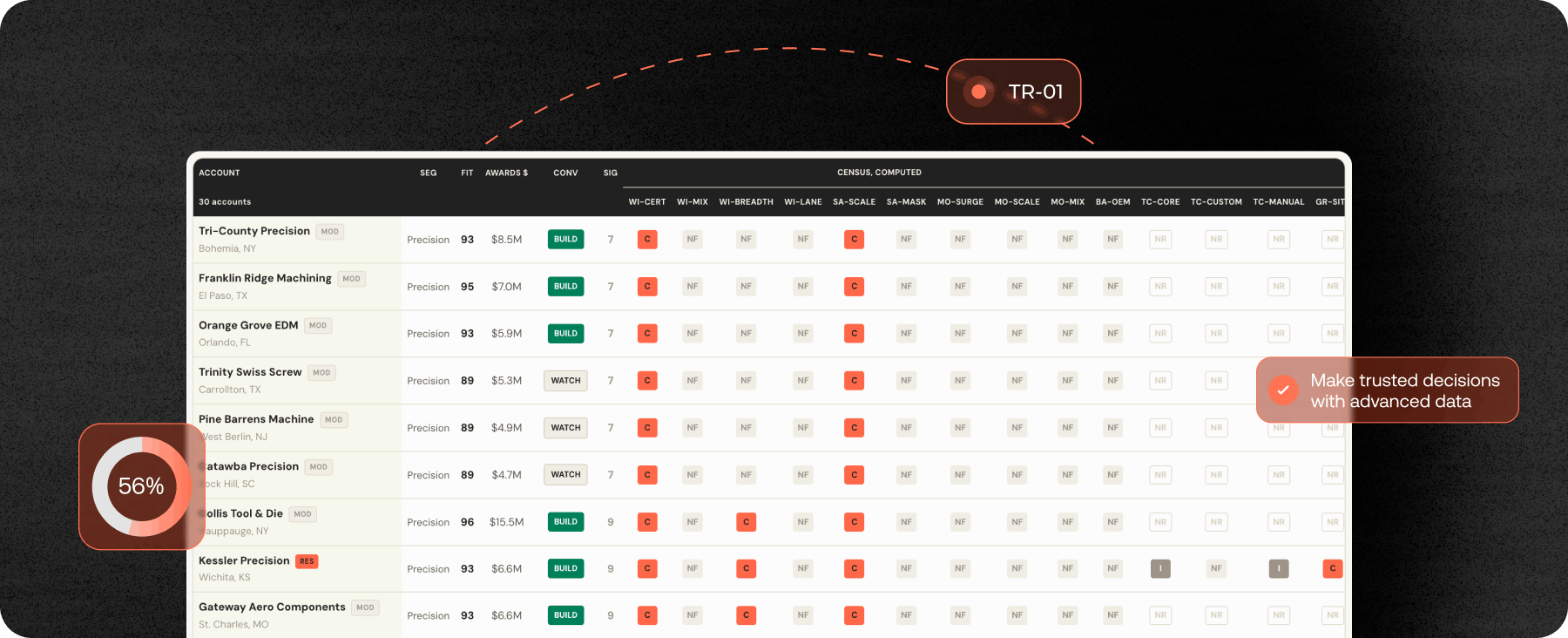
Signal Intelligence is a defined system that helps B2B go-to-market teams identify, prioritize, and activate the signals most relevant to their revenue motion. Through Signal Intelligence, Sales, Marketing, and RevOps create an evidence-based view of who to target, when to engage, and what to say.
It’s designed and directed by people and scaled by agents. GTM Strategists own the thinking and GTM Engineers own the technology. The system continuously learns and adapts as new signals emerge, while remaining grounded in a consistent set of principles.
Why do B2B teams need Signal Intelligence?
It now takes roughly 266 touches to close a single B2B deal, according to a HockeyStack Labs study. Most sales cadences are built for a fraction of that, then get categorized as “cold outreach doesn’t work.”
A lot of the signals teams count on today are actually telling them the wrong thing. Demand Science followed up directly with 5,700 accounts showing “intent” on terms like CRM and asked a simple question: are you actually in market for this? 98% said no.
And the workload keeps climbing anyway. In LeanData’s 2026 State of GTM Efficiency Report, 88% of GTM leaders said generating pipeline is challenging. Put those three numbers next to each other and a pattern shows up.
Teams are sending more outreach, with more data, using more tools, than at any point in B2B revenue history, and getting less pipeline for it. Teams scaled the easy part: touches, tools, messages. The intelligence to make sense of all those signals was never built.
As we put it in a recent episode of Sunrise: “We don’t have a signal problem. We have a wrong signal problem.”
Why did the old playbook stop working?
For about a decade, most B2B teams have had three ways to decide who to reach out to and what to say.
The first is deep, personal outreach: twenty or thirty minutes of research per account, a message built around something real. It still works. It also doesn’t scale, and it’s usually the first thing a stretched team cuts.
The second is first-line personalization: a line about a funding round, a new title, a recent post. When this showed up around 2017, it felt remarkable. By now, most buyers have already seen a version of that same line from a dozen vendors in the same week.
The third is automation at volume: send enough messages and something lands. Except every team is running that same play, at the same time, on the same accounts. Reply rates have fallen as a result, and the math stopped working.
All three lost their edge at roughly the same time, for the same reason. Each one draws from the same pool of obvious, easy-to-find information. When everyone is drawing from the same pool, that information stops being an advantage.
What does Signal Intelligence do?
In practice, the system does three things.
Identify. Most GTM teams already have plenty of data: CRM, intent, firmographic, and market data, more than they can act on. What’s missing is a filter for which of it actually predicts revenue.
Signal Intelligence starts by calibrating against what’s already closed, pulling the last twenty or so deals a company has won and reverse-engineering which signals showed up before each one. The result is usually a short list of fifteen to forty signals, the specific handful that correlates with revenue inside that company’s category.
Everything else gets deprioritized, no matter how interesting it looks on its own.
Prioritize. A signal is an observable change at an account, such as a new executive hire. An implication explains why that change matters for a specific offer right now. Signal Intelligence turns signals into implications.
Say a company hires a new CRO. The signal is the hire. The implication comes from the context around it: this CRO scaled her last company three times over in three years, she’s joining a firm that’s been flat for eighteen months, and the tech stack visibly can’t support that kind of growth. One signal is a clue. A stack of signals tells a story, and accounts are ranked by the strength of that combined story.
Operationalize. This is the part that’s easiest to skip. Once a team understands what’s actually keeping a set of buyers up at night, the right move is usually a different account list. Fewer accounts, ranked by conviction, worked in a different order, each with a specific reason it is on the list. Most teams end up working a fraction of the accounts they were touching before, and doing meaningfully better with the ones that remain.
Identify finds the signals that matter, prioritize explains why each account matters now, and operationalize turns that into a short list the whole team commits to. That list, and the reason behind each account on it, is what Story and Activate are built on.
Why is Signal Intelligence a defined system?
A one-off research project goes stale, and a tool does nothing until someone decides what it should look for. A defined system sits between the two: some parts are fixed, and others change every time it runs.
What stays the same
- Fit decides who is on the list. Signals decide the order.
- Signals are calibrated against closed-won deals, not chosen for how interesting they look.
- Every signal is paired with an implication.
- Every finding is sourced, and labeled obvious or non-obvious, confirmed or inferred. An inference is never passed off as fact.
What gets adjusted
Fit weights, signal definitions, and the signal library itself change as the market changes and as results come in. Calibration checkpoints let the team adjust them before outreach starts, and every campaign’s results feed back into the system.
Who runs it
Signal Intelligence is designed and directed by people and scaled by agents. GTM Strategists own the thinking: the fit model, the signal definitions, the implications, and the messaging strategy. GTM Engineers own the technology: data sources, tools, workflows, and the write-back into CRM. Specialized AI agents do the research volume between them. Humans keep the judgment calls.
That combination is also why Signal Intelligence is practical now. Non-obvious signals always existed, and great reps have always found them, but the research was too slow to run on more than a handful of strategic accounts. Agentic research tools make it possible to run that research across an entire account list.
What is a non-obvious signal?
A non-obvious signal is a public fact whose commercial meaning almost no one has drawn. The fact itself is rarely hidden. What’s non-obvious is the ‘so-what’, what that fact means for this account, right now, for what you sell.
Obvious signals (a funding round, a new office opening, a job posting, a tech-stack addition visible on G2) are useful. They tell you a company is doing something. They’re also visible to everyone else running the same intent platform, which means several competitors are pinging the same account in the same week with some version of the same “congrats on the new role” message. The signal is real. It’s just no longer differentiated.
Non-obvious signals take more work to find and say something more specific. A CEO who mentions the same internal methodology across several recent podcast appearances. A public meeting agenda, buried several pages in, that shows a vendor RFP is already in motion. A product page that’s dropped a feature it used to advertise. A cluster of Glassdoor reviews that all point at the same internal friction. None of these show up in a standard intent feed. Each one is a current, concrete detail about what a specific account is actually living through, which is exactly what makes it useful.
A signal counts as non-obvious when it passes three tests.
- It is specific:true of this account right now, not every company in the segment.
- It is consequential: it creates a problem or opportunity your offer directly solves.
- It is unique: no competitor is likely acting on it yet.
An old mining distinction is useful here: panning a creek for visible flakes of gold, versus learning to read the veins running through the rock underneath.
The flakes aren’t worthless. They’re just where everyone else is already standing.
What Signal Intelligence is not
Signal Intelligence is not intent data. Intent platforms that track when an account is researching topics like yours are a real input, but a narrow one, as the Demand Science numbers above show. Intent tells you a topic is being searched. It leaves out why, who’s searching, and whether it means anything for your specific offer. Most intent scores can’t be inspected, and a signal you can’t inspect is hard to trust or prioritize. Signal Intelligence weighs intent alongside everything else it tracks, as one piece of a bigger picture.
Signal Intelligence is not personalization or outreach automation. Referencing a LinkedIn post or a funding announcement in an opening line is a delivery tactic, layered on top of whatever signal was easiest to find. Signal Intelligence is the work that decides which accounts and which reasons deserve attention in the first place. Personalization comes after that decision.
Signal Intelligence is not a data vendor or a software platform. Plenty of GTM teams are data-rich and signal-poor. They have more account, market, and pipeline data than they can act on, and still work from inconsistent target lists and manual research because no one has decided which of that data matters. Data vendors sell lists and scores. Signal Intelligence decides which signals matter for a specific business, stacks them into account-level context, and activates them in messaging and outreach. The platform isn’t the program.
Sales intelligence is a related but distinct term, covered in our comparison of Signal Intelligence, intent data, and sales intelligence.
Who is Signal Intelligence for?
Signal Intelligence pays off most in B2B markets where it is hard to stand out and timing matters:
- Long sales cycles. The buyer’s direction is often set long before an RFP or specification exists. Signals let a team show up while the project is still taking shape.
- Large enterprise deals. Buying committees, not single buyers, make the decision. Signals help a team find who owns the project, who controls the specification, and who signs.
- Highly competitive markets. When every competitor has the same intent feed, obvious signals become a race to send the same email first. Non-obvious signals are the one input competitors can’t buy.
It fits less well in short, transactional sales, in very early-stage companies without much closed-won history, and in markets small enough that a team already knows every buyer by name.
How does Signal Intelligence fit Signal, Story, and Activate?
At JumpSeat, Signal Intelligence powers the first stage of a connected go-to-market model.
- Signal finds the opportunity: which accounts matter, why, and when the window is open.
- Story turns what is happening into a distinctive, relevant reason for the buyer to engage.
- Activate puts that strategy and story into market through coordinated outreach, creative, paid media, and execution.
Signal Intelligence hands off a prioritized account list with a reason behind every account; Story and Activate turn those reasons into messages and pipeline. The flow runs Signal → Story → Activate → pipeline.
What changes when a team has this
The end-result of Signal Intelligence is a different kind of GTM team. A team working from a single prioritized account list everyone actually believes in, with a visible, specific reason each account is on it, and messaging that reflects what’s actually happening at that account instead of a template filled in with a first name and a recent headline. On a signal-centric team, every dollar and every hour is signal-based and signal-backed.
Ready to find out which signals actually predict your next closed deal?
About the author
Dan Ptak is the Founder and CEO of JumpSeat, a B2B growth agency and advisory built around a signal-led approach to go-to-market. He writes Sunrise, a B2B GTM strategy newsletter on LinkedIn, and hosts the Signal Series on Signal Intelligence.